
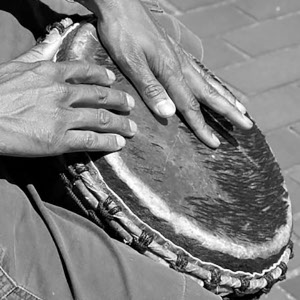
I sometimes compare painting and hand drumming—each discipline helps me understand the other.
Copying the Masters
When I was in school studying art, I was asked to copy paintings by the Masters—a common practice. The point wasn’t imitation for its own sake; it was to inhabit the mind and heart of the original artist. By rebuilding the composition and palette, we begin to glimpse the intelligence that shaped the piece.
I’ve always seen this as a way to empower the novice with possibilities. Masterworks contain ideas worth pondering—worth emulating as a path, not a destination. Copying is a means to uncover our own aesthetic and visual intelligence. In other words: copy to study, not study to copy. We copy the Masters to study… ourselves.
Here’s an instructive story from Sue Greg Wison’s book, The Drummer’s Path (Destiny Books, 1992), that centers this concept in the world of hand drums:
“I once heard a story about Balogun when he went to West Africa. A lead drummer for the Chuck Davis Dance Company, he had been around the African scene for years and had received much exposure and experience in traditional African drums and ceremony. When he finally crossed the waters and got back Home, he played and played, sharing his knowledge of ‘the Culture’ with his brothers in the Motherland. They were impressed. They nodded, and smiled appreciatively.
And when he was done, they said (politely, through an interpreter), ‘That was very good, what you have learned of our traditions. But tell us,’ they asked, ‘what do your people do?’ He had no answer.”
— Sue Greg Wilson, The Drummer’s Path (Destiny Books, 1992)
And from Master drummer, Mongo Santamaria –
“In the neighborhood where I came from we had all kinds of music, mostly from Africa. We did not leave it alone; we changed it our way. The music we made dealt with religion and conversation. The drum was our tool and we used it for everything.”
— Mongo Santamaría
These stories have been rumbling around in my head for decades. I have come to the conclusion that the study of the rhythms of Africa (and Her Diaspora) not only brings us closer to an unparalleled social/spiritual/art form from a wide variety of distinct cultures, the material also acts upon us like keys, helping to unlock the inherent rhythmic intelligence we all possess.
At least, that’s how I see it.
~ Will

Leave A Comment