
The“Call of the Drum!”
Feel like joining a drum circle? Want to take a class? Well, you’re eventually going to need your own drum!
But which one? When shopping for a hand drum, you essentially have two sound profiles to choose from – the brightness of a goat skin drum or the warmth of a cow skin drum, available in five main choices:
- The Conga (cow skin)
- The Djembe (goat skin)
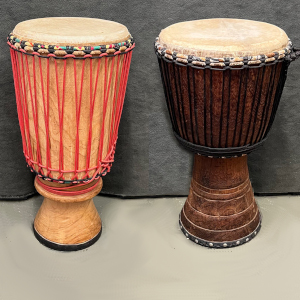
- The Ashiko (goat skin)
- The Cowshiko (cow skin)
- The Bougarabou (cow skin)
Before we talk about the drums let’s first consider these two important factors:
- Where you plan to play
- With whom
Getting clear about these questions will help you make the best choice. Here are some typical settings that hand drummers find themselves in:
- Loosely guided drum circles (inside)
- Loosely guided drum circles (outside)
- Study groups with a teacher (inside)
- Band practice with many instruments, you as the percussionist (inside)
- Dance Class (inside)
Generally speaking, goat skin drums do really well outside because they are loud! (Cow skin drums can work outside, too, but one has to play a lot harder to be heard).
And generally speaking, cow skin drums work well indoors. (Goat skin drums can work inside, too, though one should be mindful not to play too loud!)
When you have a teacher you are working with, I suggest you check in with them to see what drum would be appropriate for their class.
If you sign up for a traditional djembe class, you don’t want to show up with a cow skin drum! (You may, however, be able to bring an Ashiko with a goat skin). Conversely, if you sign up for a conga class, you don’t want to show up with a goat skin drum.
If your teacher is working with rhythms from a variety of different cultures (as I do) then a cow skin drum may be the most practical choice, though a goat skin drum works well in arrangements that ask for a ‘high’ part. Again, check in with your teacher!
Most common hand drums to consider…
Djembe
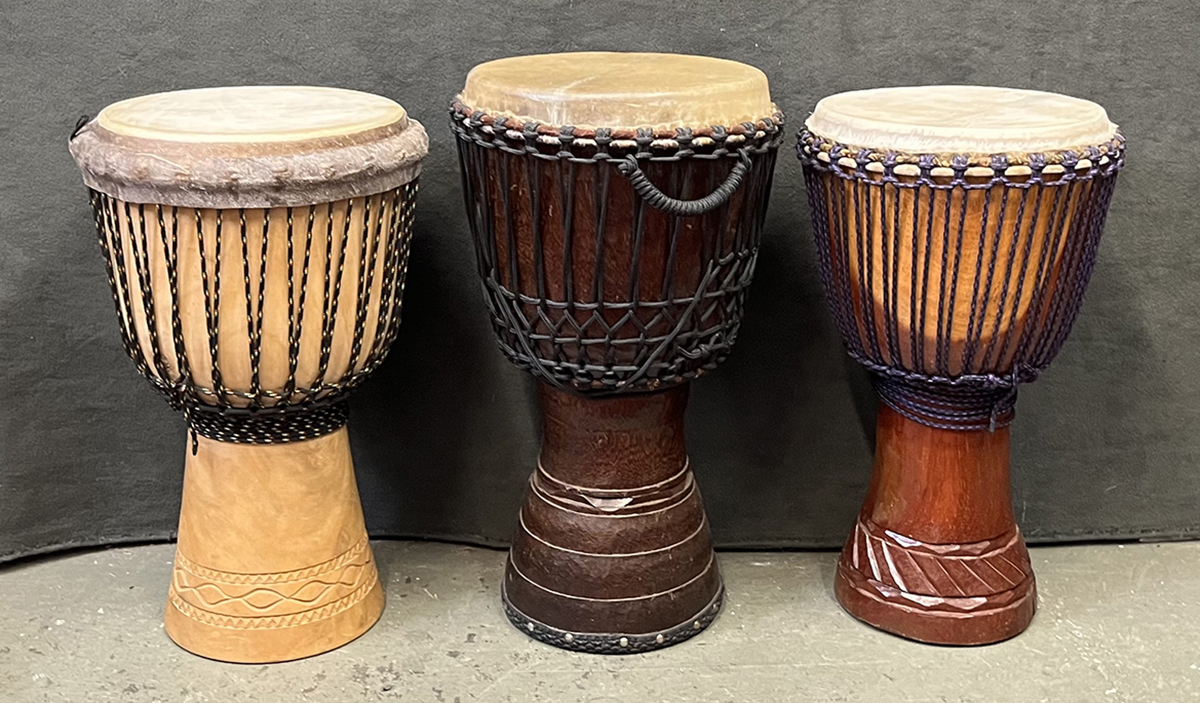
The world’s most dynamic drum?!
Birthed in the Mande Empire (West Africa), this goblet shaped drum, hand-carved from a single piece of hardwood, is typically headed with a goat skin (much thinner than cow skin), and is known for its incredible range of sound. (Typically 24” tall with an average head diameter of 12” – 13”)
Pros
- Gigantic bass note! Sharp slap! Bright tone!
- Loud when you want, soft and delicate when you want.
- Great for ‘cutting through’, when you need to be heard (dance class or drum circle).
- Portable
- You can play standing up (with a strap) or sitting down.
Cons
- Not a particularly warm tone. (Often described as ‘tinny’)
- Not easy to master technique. (Especially the ‘tone’ and the ‘slap’)
- Skins can rip or tear, needing repair.
- Rope tuned… can seem complicated to tune (though once you learn, it is easy!)
Congas
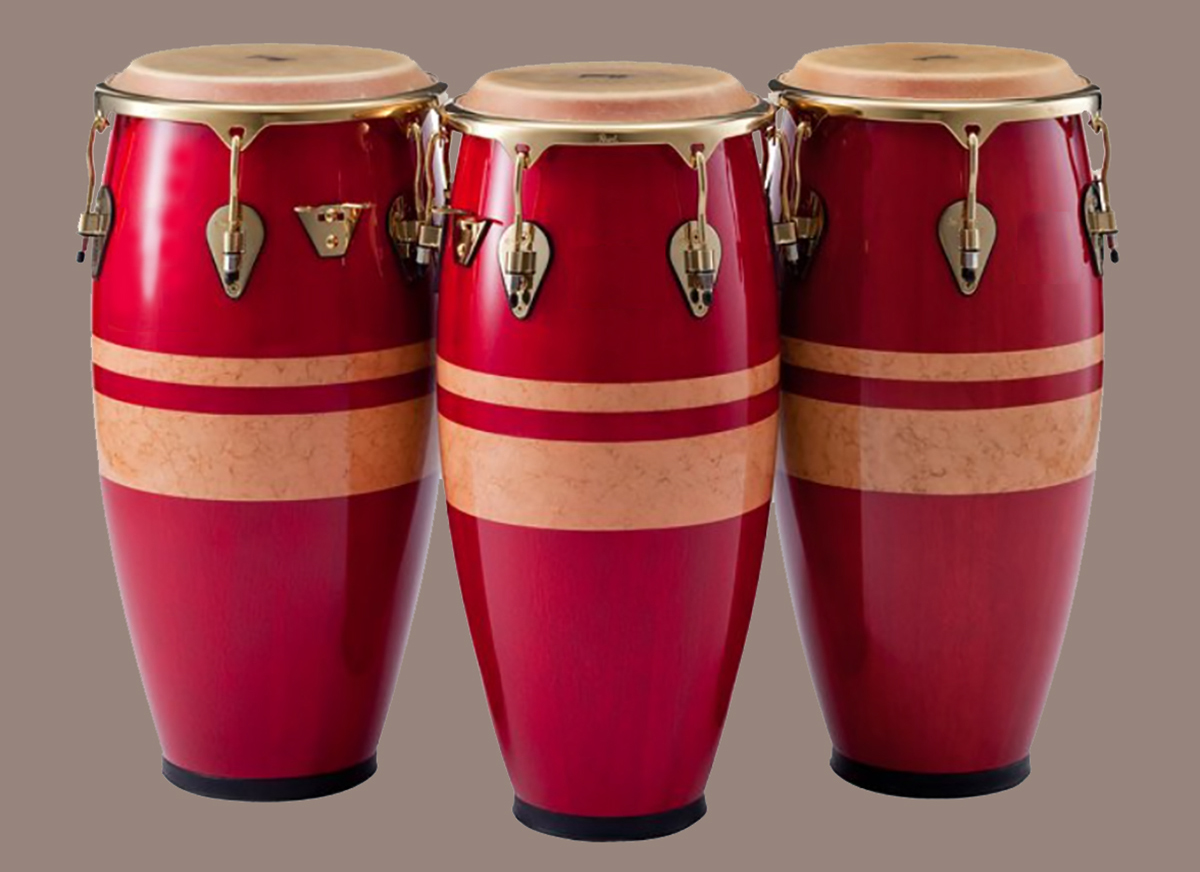
A family of Afro-Cuban drums from Cuba (with its roots in Africa) usually around 30” high, with three main head sizes:
- “Tumba” – Low pitched (12″ & 1/2″ – 13″ head diameter)
- “Conga” – Middle pitched (11″ – 11 & 1/2” head diameter)
- “Quinto” – High pitched (10″ head diameter)
Congas are usually headed with cow or water buffalo skins (much thicker than goat skin)
Pros
- The warm tone!
- They “play well with others”. They sound great in most band settings.
- Easy, quick tuning with a drum wrench.
- Congas can be tuned to a variety of tonal ranges.
- They are great in groups studying a variety of drum styles.
- Heads are very durable.
- Easy to care for.
Cons
- Not very portable. They are big and heavy and not easy to lug around.
- Not much of a bass note.
- Not as loud as some other drums. You have to hit a bit harder to be heard in loud settings (dance classes and drum circles) which can lead to bruised hands!
Ashikos

A conical drum, popular for its ability to simulate the sound of both the djembe (when headed with a goat skin) and the conga (when headed with a cow skin). A favorite among drum builders since it can be assembled with wood staves, rather than being hand carved from a single log.
Pros (Ashiko w/ goat)
- Has a big range of sound (like a djembe! The bass note is not quite as low and rich as the bass note from a djembe…but not far off!)
- Very portable.
- Lightweight.
- Great for drum circles.
Cons (Ashiko w/ goat)
- Many ashikos on the market are headed with goat skins that are, in my opinion, way too thin! (Not all goatskins are created equal. A nice medium-thick or thick goat skin can help offset the ‘tinny’ sound often equated with this drum)
- Challenging to get a clear difference between the tone and slap technique (especially with a thin goatskin!)
- Rope tuned… challenging for a hot second, but easy once you learn.
Cowshiko (an Ashiko with a cow skin)
Pros
- With the right cow skin (medium thick) this drum provides a great tone, a punchy bass, and an easy slap.
- Portable! Lightweight!
- Plays well with others.
- Tunable to many tonal levels.
Cons
- Sometimes not loud enough for a dance class or drum circle.
- If headed with a thicker cow skin, the drum can sound a little dull.
Bougarabou
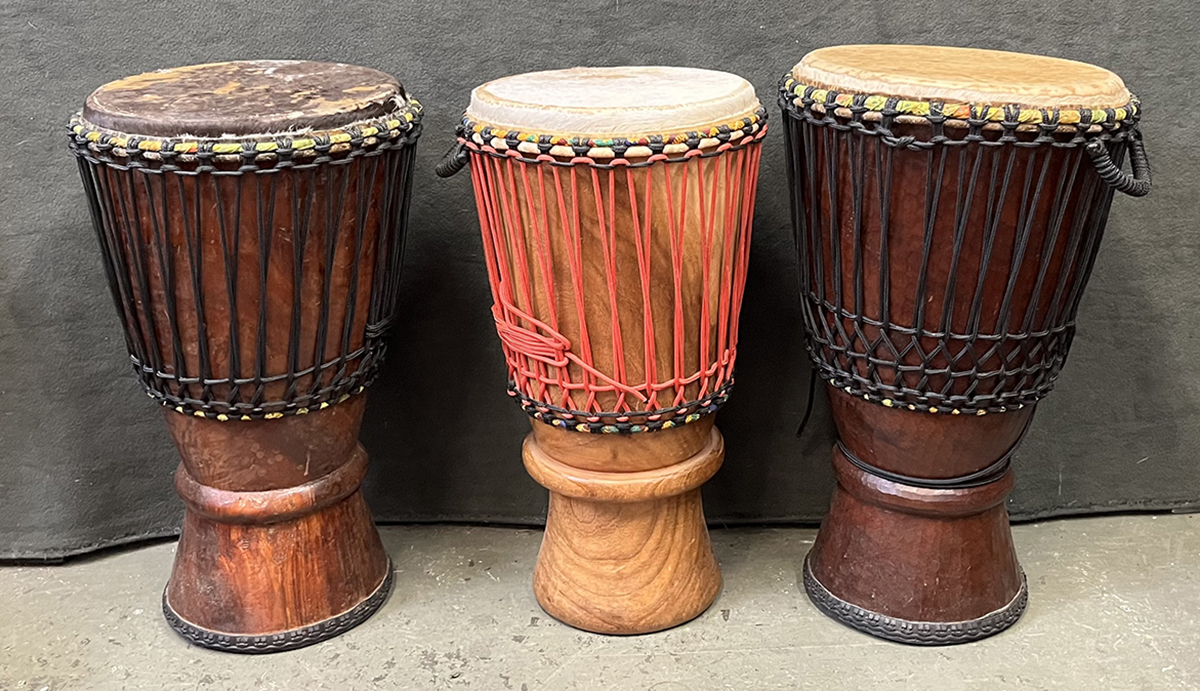
Basically a cross between a conga and a djembe: A giant bass and a warm tone.
Originating from the Jola people of The Casamance (Southern Senegal) the bougarabou is traditionally a tall set of 3 or 4 drums in different head diameters (like congas) played standing up, leaned against a stand. Traditionally, the drums are peg—tuned.
They are now being carved and sold in stores in a more accessible format (see picture): A djembe-esque appearance, (though with a longer more, tapered bowl), 24” – 25” tall, played sitting down and rope tuned.
The bougarabou usually has an accent ‘ring’ carved down art the bottom of the bowl, just above the opening.
Pros
- They sound incredible! Big bass (almost as big as djembe), super warm tone (like a conga) and a crisp slap.
- They can be tuned to a variety of tonal levels.
- They play well with others!
- Portable
- Cow skins are very durable. They rarely need to be replaced.
Cons
- Maybe not loud enough for outdoor drum circles, unless headed with a “thin cow”! (In general, cow skins are much thicker than goat skins, and therefore produce a really nice warm tone… but cow skins still come in a range of thicknesses! A thinner cow skin – still much thicker than a goat – can sound “djembe-esque”. A thicker cow skin breaks more towards the sound of a conga)
Synthetic Heads
Nowadays, drum companies offer synthetic heads for congas, ashikos and djembes as alternatives to animal skins.
My verdict: I prefer natural skins! For me, they feel and sound better. But if I have to weigh in…
- Synthetic conga heads can sound great. Very professional. Easy on the hands. Note: For schools and drum circle facilitators, Remo (percussion company), makes a lovely line of affordable synthetic drums — colorful, tubular — called Tumbanos, that sound warm and project well).
- Synthetic ashiko and djembe heads just don’t sound good… too tinny! Too synthetic! Sorry, Remo.
My final thoughts on choosing a drum
If it feels good to play, and it calls to you (and it fits the environment you see yourself playing in)… grab it!
~ Will
Leave A Comment